
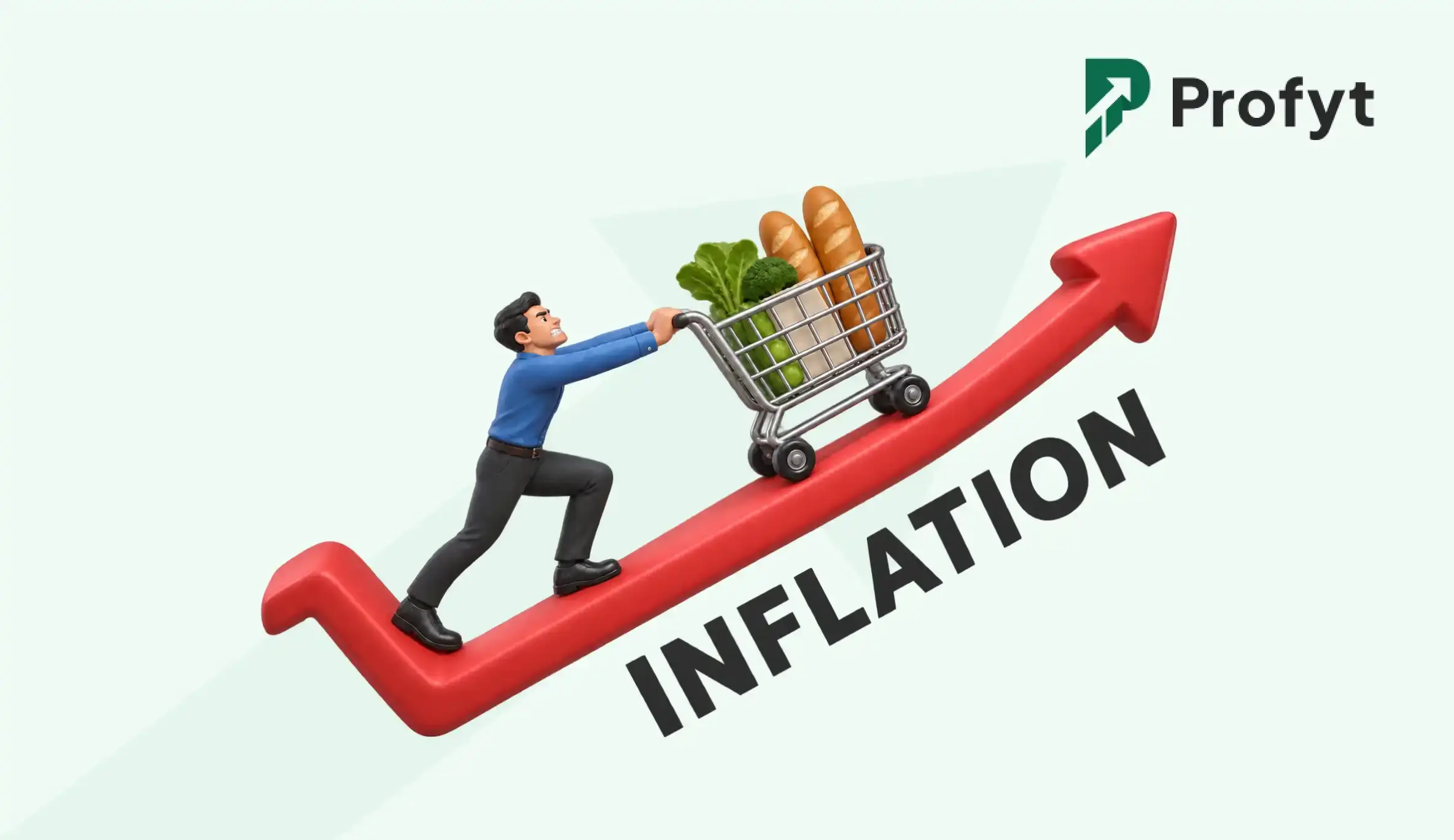
What is inflation?
Inflation is the rate at which the general price of goods and services rises over time. When inflation is 5%, something that cost ₹100 last year costs about ₹105 today. Your money buys a little less every year, even if the number in your bank account stays the same.
In India, the main indicator is the Consumer Price Index (CPI), published monthly by the Ministry of Statistics (MoSPI). It tracks the price of a typical household basket: food, fuel, housing, clothing, health, education and transport. The Reserve Bank of India (RBI) aims to keep CPI inflation at 4%, within a band of 2% to 6%.
Inflation usually comes from three forces:
- Demand-pull: too much money chasing too few goods, for example when incomes and credit grow faster than supply.
- Cost-push: rising input costs such as crude oil, wages or raw materials get passed on to buyers.
- Supply shocks: a poor monsoon, war or supply-chain breakdown suddenly cuts supply of food or fuel.
A little inflation is normal and even healthy for a growing economy. The problem starts when it runs ahead of your income and your savings.
India's inflation over the years
India's inflation has come down sharply over the last decade, but it is rising again: CPI inflation hit 5.54% in September 2026, up from 3.48% in April.
RBI and MoSPI CPI data, annual averages approximate; September 2026 from MoSPI provisional release
In 2012–14, food and fuel prices kept inflation near 10%. In 2016 the RBI adopted a formal 4% inflation target, and prices stayed mostly inside the 2–6% band after that. The COVID-19 supply shock and the 2022 Russia–Ukraine war pushed inflation above 6% again, before cheap food and GST cuts drove it to a record low of about 2% in 2025–26.
How inflation affects your income
Inflation quietly cuts what your salary and savings can buy.
Your pay rise may be smaller than it looks. Suppose you get an 8% hike in a year when inflation is 5.5%. Your real raise is only about 2.4% (1.08 ÷ 1.055 − 1). If your hike is 4% and inflation is 5.5%, you are actually poorer than last year.
Idle cash loses value every year. At 6% inflation, ₹1,00,000 kept in cash buys only what about ₹55,800 buys today after 10 years. Money in a savings account earning 3% still shrinks in real terms, by roughly 3% a year.
For sustaining wealth, your income and investments must grow at least as fast as inflation.
FD vs Nifty 50 vs inflation: the last 10 years
Over the 10 years to September 2026, the Nifty 50 beat inflation by about 6 percentage points a year, while a fixed deposit stayed only about 1 point ahead, and that is before tax.
| ₹1 lakh invested in Sept 2016 | Value in Sept 2026 | 10-year return (per year) | Real return after inflation |
|---|---|---|---|
| Nifty 50 (with dividends) | ₹2.96 lakh | 11.47% | ~6.1% |
| SBI 1-year FD, renewed yearly | ₹1.85 lakh (before tax) | 6.36% | ~1.2% |
| Inflation (cost of the same goods) | ~₹1.63 lakh | ~5% | — |
This computation is for education only and is not investment advice. Past returns do not guarantee future results.
Inflation assumed at about 5% a year over the period.
In other words, what cost ₹1 lakh in 2016 costs about ₹1.63 lakh today. The FD barely kept up, and after 30% tax its return drops to about 4.5% a year, below inflation. The Nifty 50 nearly tripled the money and grew its real buying power by about 80%, though with sharp ups and downs along the way. Equity rewards patience, not short holding periods.
The bottom line: make your money outrun inflation
Inflation is a silent tax. It never shows up on your payslip or bank statement, yet it takes a slice of your money's value every single year. You cannot stop it, but you can plan around it.
Plan every goal in future rupees, not today's. At 6% inflation, a goal that costs ₹10 lakh today will cost about ₹18 lakh in 10 years.
The goal is not just to have more money tomorrow. It is to make sure that money can still buy the life you are working for. Start early, stay invested, and let time do the heavy lifting.
Sources
Invincible Minds Private Limited (Profyt) · AMFI Registered MFD · ARN 365266
Disclaimer
This brief is for information and education only. It is not investment advice, a recommendation, or an offer to buy or sell any security or mutual fund scheme. It is not sponsored, endorsed or approved by SEBI, AMFI or any mutual fund house. News items are summarised from the publications named; rights remain with the original publishers. Past performance may or may not be sustained in future. Mutual fund investments are subject to market risks; read all scheme related documents carefully before investing.